Our view of the industry sector
Know what we do Know what happened
Know what we do Know what happened
Entering the German vape market requires more than simply meeting European regulations. For manufacturers, importers and distributors, understanding E-Cigarette Regulations Germany is essential before launching, importing or distributing vaping products.
Germany follows the European regulatory framework established by the EU Tobacco Products Directive (TPD) while implementing additional national requirements through the German Tobacco Products Act (Tabakerzeugnisgesetz, TabakerzG) and the Tobacco Products Ordinance (Tabakerzeugnisverordnung, TabakerzV).
For businesses planning to supply e-cigarettes, vape devices or nicotine-containing e-liquids to Germany, compliance must be considered during product development, packaging design and supply-chain planning.
This guide explains the key requirements for entering the German market, including:
Germany applies e-cigarette regulations through a combination of European and national legislation.
The regulatory framework can be summarized as:
EU TPD Article 20 → German TabakerzG → German TabakerzV → EU-CEG Notification → German Market Placement
The EU Tobacco Products Directive provides the foundation for electronic cigarette regulations across Europe. However, each member state implements these rules through national legislation.
For manufacturers, this means that EU compliance alone does not automatically guarantee successful market entry in Germany.
Products must also meet German requirements regarding:
The main European legal framework for nicotine-containing electronic cigarettes is Article 20 of Directive 2014/40/EU, commonly known as the Tobacco Products Directive.
Germany implements these requirements through:
These regulations define how manufacturers and importers must prepare products before they are placed on the German market.
For vape companies, compliance should follow this order:
Product Design → Regulatory Review → EU-CEG Notification → Packaging Approval → Production → Distribution
Preparing compliance documentation after production can create unnecessary delays, especially when packaging or product specifications need modification.
One of the most important steps under E-Cigarette Regulations Germany is submitting product information through the European Common Entry Gate (EU-CEG).
Before placing new electronic cigarettes or refill containers on the German market, manufacturers and importers must complete notification procedures.
Germany requires notification through EU-CEG before market introduction, allowing authorities to review product information and monitor products available in the market.
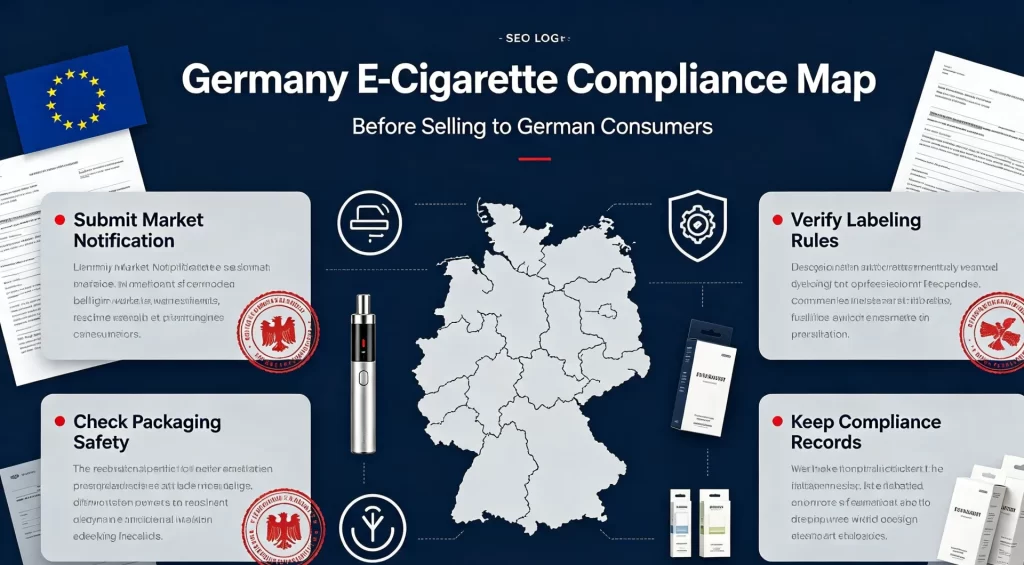
Manufacturers must prepare detailed technical information, including:
The submitted information should match the final commercial product.
For example:
may require compliance review before implementation.
For manufacturers, EU-CEG preparation should therefore be connected with product documentation management rather than treated as a separate administrative step.
German regulations establish specific technical requirements for nicotine-containing electronic cigarettes and refill containers.
These requirements directly affect:
The main product limitations include:
| Requirement | Germany Requirement |
|---|---|
| Maximum nicotine concentration | 20 mg/ml |
| Maximum refill container volume | 10 ml |
| Maximum cartridge or tank capacity | 2 ml |
| Consistent nicotine delivery | Required |
| Child-resistant design | Required |
| Tamper-resistant protection | Required |
| Leakage protection | Required |
These limits apply to nicotine-containing vaping products placed on the German market.
Manufacturers developing products specifically for Germany should consider these requirements during the design stage rather than modifying products after production.
German e-cigarette regulations require products to include safety features designed to reduce risks for consumers.
Products must include:
Packaging and product systems must prevent easy access by children.
Products should provide protection against unauthorized opening or interference.
Devices and refill systems must minimize leakage during normal use, storage and transportation.
These requirements are especially important for:
For OEM manufacturers, these design requirements should be included in product specifications before mass production.
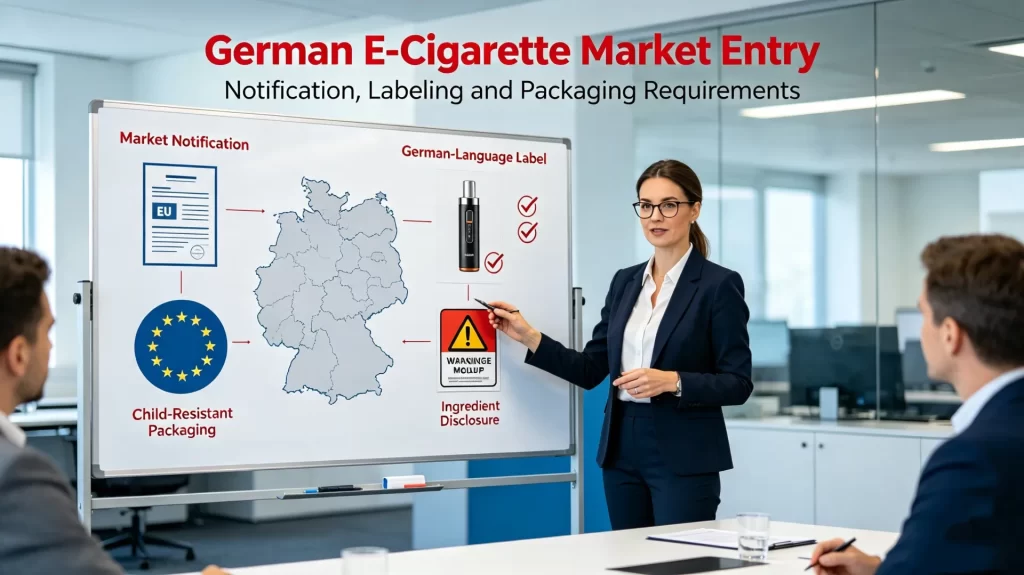
Packaging compliance is one of the most important parts of E-Cigarette Regulations Germany.
For manufacturers and importers, packaging is not only a branding element but also a regulatory document. Incorrect labeling, missing information or inconsistent artwork may prevent products from being legally placed on the German market.
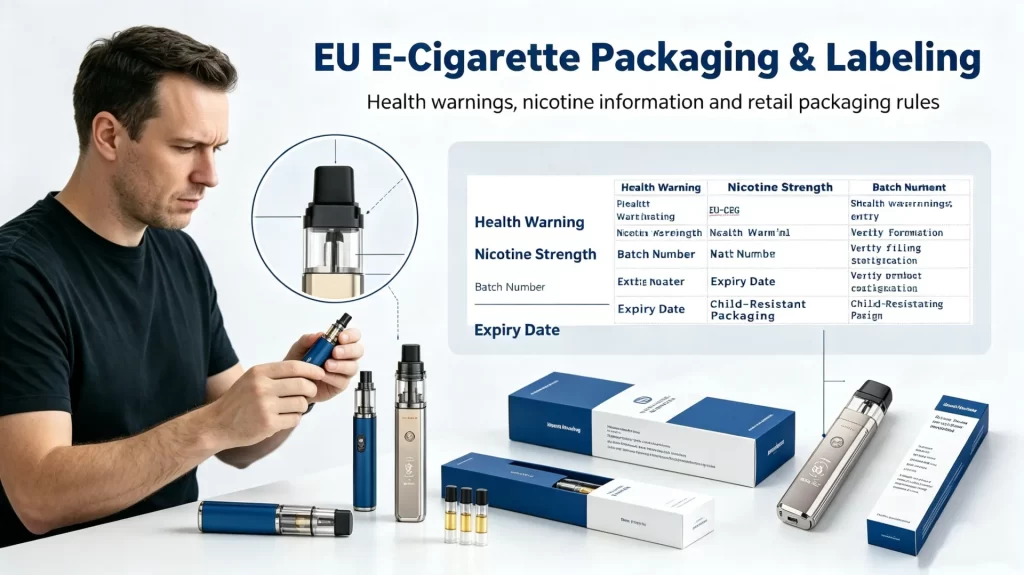
Under German regulations, packaging and outer packaging must provide specific product information, including:
All information must accurately match the product data submitted through EU-CEG.
Before approving final packaging artwork, manufacturers should verify that labels include all required information.
Key packaging requirements include:
| Packaging Requirement | Description |
|---|---|
| Ingredient list | Ingredients must be listed according to regulatory requirements |
| Nicotine content | The nicotine concentration must be clearly indicated |
| Nicotine delivery information | Required information regarding nicotine delivery must be provided |
| Batch identification | Products must include batch or production identification |
| Safety information | Required warnings and consumer information must be displayed |
For international manufacturers, German packaging compliance should not be treated as a simple translation task.
A compliant label requires coordination between:
Product Formula → EU-CEG Data → Packaging Artwork → Final Production
Any inconsistency between these elements may create compliance risks.
Nicotine-containing electronic cigarettes and refill containers must display the required health warning.
The warning must appear on the two largest surfaces of the packaging and cover the required percentage of those surfaces according to German implementation of EU requirements.
Because packaging space is limited, manufacturers should consider regulatory requirements during the packaging design stage.
Common mistakes include:
For companies producing multiple markets, Germany-specific packaging versions may be necessary.
In addition to packaging requirements, German vape products must include a compliant instruction leaflet.
According to German regulations, the leaflet must contain the heading:
“Gebrauchsinformation”
The information must be written in German and presented in a clear and understandable format.
The instruction leaflet should include information related to:
For international vape manufacturers, the leaflet should be developed as a separate compliance document rather than simply translated from another market version.
A professional localization process should review:
Compliance with E-Cigarette Regulations Germany also involves ingredient control and refill-system requirements.
Manufacturers should evaluate the entire product chain:
E-liquid Formula → Ingredient Review → Device Components → Refill System → Leakage Protection → EU-CEG Documentation
German regulations include restrictions on certain ingredients used in electronic cigarettes and refill containers.
Before launching a new product, manufacturers should confirm:
Any modification to formulation or device construction should be reviewed before implementation.
Product compliance does not end after manufacturing.
Companies entering the German market must also consider restrictions on advertising and marketing communication.
German regulations restrict advertising for electronic cigarettes and refill containers in areas including:
There are limited exceptions for certain professional trade publications intended for businesses operating within the industry.
Germany also restricts outdoor advertising for electronic cigarettes and refill containers, with specific exceptions related to specialist retail locations.
For manufacturers and suppliers operating websites, marketing content should clearly distinguish between:
Examples:
and:
Examples:
For B2B vape websites, technical and compliance-focused content is generally more appropriate for communicating with professional buyers.
Youth protection is another important part of Germany vape regulations.
German youth-protection rules apply to electronic cigarettes, including nicotine-free products.
Restrictions cover:
Manufacturers and distributors should ensure that their sales channels include appropriate age-control measures.
For online businesses, compliance should be reviewed across:
Before launching vape products in Germany, manufacturers should review the following areas:
For manufacturers, the correct compliance sequence should be:
Product Specification
↓
German Regulatory Review
↓
EU-CEG Notification
↓
Packaging and Artwork Approval
↓
Production
↓
Warehouse Allocation
↓
Market Distribution
European warehouse availability can improve logistics efficiency, but storage location does not replace regulatory compliance.
Products should complete the necessary compliance steps before inventory is allocated for German distribution.
Yes. Electronic cigarettes are legal in Germany, but products containing nicotine must comply with EU and German regulatory requirements before being placed on the market.
Yes. Manufacturers and importers must submit product information through EU-CEG before placing regulated e-cigarette products on the German market.
The maximum permitted nicotine concentration for nicotine-containing e-liquids is 20 mg/ml.
Prefilled cartridges and tanks used with nicotine-containing products are limited to a maximum capacity of 2 ml.
Yes. Product information and instruction leaflets must meet German language and regulatory requirements.
Understanding E-Cigarette Regulations Germany is essential for manufacturers, importers and distributors planning to enter one of Europe’s largest vape markets.
Successful market entry requires more than producing a compliant device or e-liquid. Companies must coordinate:
By integrating compliance into the product development process, manufacturers can reduce packaging revisions, avoid documentation problems and build a stronger foundation for long-term business growth in Germany.
This article provides general regulatory information and does not constitute legal advice.
No Next Post