Our view of the industry sector
Know what we do Know what happened
Know what we do Know what happened
EU e-cigarette regulations are an essential consideration for manufacturers, importers, distributors and B2B suppliers planning to enter European markets.
At EU level, the main legal framework is the Tobacco Products Directive (TPD), Directive 2014/40/EU. Article 20 establishes specific requirements for electronic cigarettes and refill containers, covering product notification, nicotine concentration, container capacity, product safety, packaging, labeling and commercial communications.
However, complying with EU-level requirements does not automatically mean that a product can be sold in every European country without further review. Each EU Member State may introduce additional national requirements relating to taxation, language, advertising, distance selling, registration, enforcement and market restrictions.
This guide explains the main EU e-cigarette regulations in 2026, including TPD Article 20, EU-CEG notification, product specifications, packaging requirements and national compliance considerations.
For businesses preparing an e-cigarette product for the European market, the compliance process can generally be understood as:
EU TPD → TPD Article 20 → EU-CEG Notification → Product Compliance → Packaging & Labeling → National Market Review
The key point is that EU rules provide a common regulatory framework, while individual Member States may apply additional national requirements.
| Compliance Area | EU-Level Requirement | Business Check |
|---|---|---|
| Product notification | EU-CEG notification | Submit before market entry |
| Nicotine strength | Maximum 20 mg/ml | Verify formulation |
| Refill containers | Maximum 10 ml | Verify filling specification |
| Cartridge/tank capacity | Maximum 2 ml | Verify product configuration |
| Product safety | Child-resistant, tamper-resistant and leak-resistant requirements | Review product design |
| Packaging | Ingredient and nicotine information plus health warning | Review packaging artwork |
| Leaflet | Required consumer information and safety instructions | Prepare required content |
| Advertising | Restrictions on certain commercial communications | Review marketing strategy |
| National requirements | Member State-specific rules may apply | Check target country |
The Tobacco Products Directive 2014/40/EU, commonly known as the TPD, provides the main EU-level regulatory framework for tobacco products and related products such as consumer electronic cigarettes.
For e-cigarette businesses, Article 20 is particularly important because it establishes requirements specifically applicable to electronic cigarettes and refill containers containing nicotine.
The TPD framework covers areas such as:
Businesses should therefore consider TPD compliance during product development rather than treating regulatory review as a final pre-launch step.
Article 20 is one of the most important sections of the TPD for manufacturers and importers of nicotine-containing e-cigarette products.
Under the current EU framework, key requirements include the following.
Nicotine-containing liquid placed on the EU market must not exceed a nicotine concentration of 20 mg/ml.
Manufacturers should verify the formulation and supporting documentation before beginning the EU market-entry process.
Nicotine-containing refill containers are subject to a maximum capacity of 10 ml.
Product specifications, filling processes and packaging should therefore be checked against this requirement.
Disposable electronic cigarettes, single-use cartridges and tanks are subject to a maximum liquid capacity of 2 ml under the TPD framework.
This requirement should be considered during product engineering because changing the physical configuration after production can create additional compliance and packaging issues.
Products must incorporate appropriate child-resistant and tamper-resistant features.
Manufacturers should maintain supporting technical documentation demonstrating how the relevant safety requirements are addressed.
Electronic cigarettes and refill containers must be designed to reduce the risk of breakage and leakage during normal handling and use.
Refill mechanisms should also be designed to minimize leakage.
The TPD requires nicotine delivery to be consistent under normal conditions of use.
This makes product testing and quality-control procedures important parts of the compliance process.
Another major component of EU e-cigarette compliance is product notification through the EU Common Entry Gate (EU-CEG).
Manufacturers and importers are generally required to submit information to the relevant Member State authorities six months before a new or substantially modified electronic cigarette or refill container is intended to be placed on the market.
EU-CEG notification may involve information such as:
EU-CEG should therefore not be treated as a simple administrative registration.
The product formulation, technical documentation, testing data and compliance information should be prepared and aligned before notification.
Before submitting a notification, manufacturers and importers should establish a structured compliance file.
A practical preparation process may include:
Document the product's:
Prepare information concerning:
Depending on the product and applicable requirements, supporting information may include:
The compliance file should also contain appropriate information regarding:
Preparing this information before notification can help reduce delays and inconsistencies during the market-entry process.
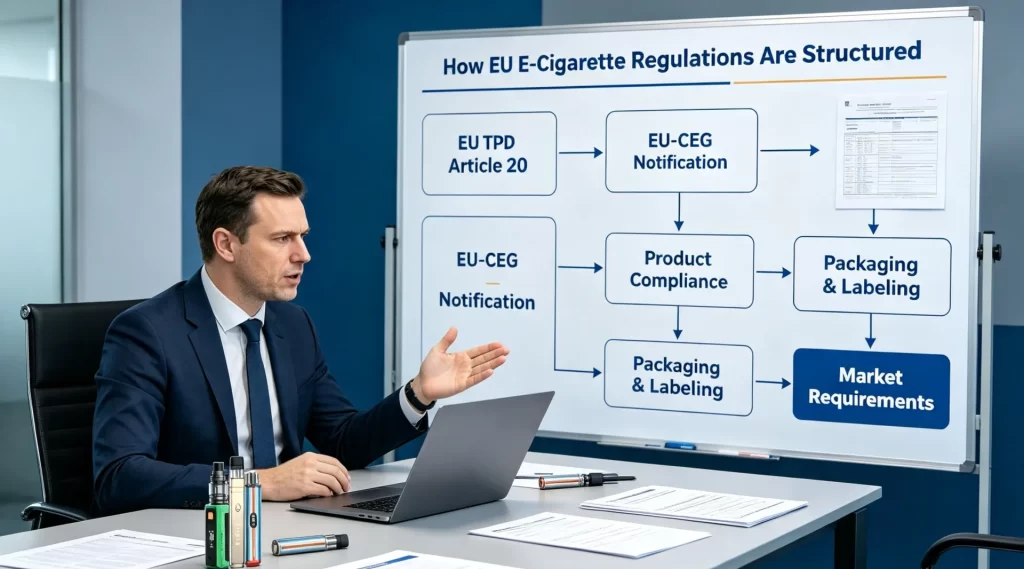
Packaging is another major area of EU e-cigarette compliance.
Under Article 20, electronic cigarette and refill-container packaging must provide specific consumer information.
Depending on the product and packaging format, businesses should review requirements concerning:
Nicotine-containing products must carry the applicable health warning required under the TPD framework.
The wording, presentation and language requirements should be checked carefully before packaging artwork is finalized.
Unit packets must include a leaflet containing required information for consumers.
This can include information relating to:
For this reason, packaging should be treated as a regulatory compliance document, not simply as a graphic-design project.
Before approving packaging artwork, businesses should review:
Packaging should be reviewed against the requirements of each target market before production.
EU e-cigarette regulations also affect how businesses promote electronic cigarettes and refill containers.
Article 20 restricts certain commercial communications intended to directly or indirectly promote electronic cigarettes and refill containers through specified media and communication channels.
These restrictions can affect:
An important exception exists for publications intended exclusively for professionals in the electronic-cigarette trade.
For B2B websites, businesses should distinguish between:
Technical product information and promotional marketing communication.
A product page explaining technical specifications, ingredients, compliance documentation and product characteristics may have a different regulatory profile from a page designed primarily to encourage consumer purchases.
Companies selling to European distributors should therefore review their website structure and marketing strategy carefully.
One of the most common compliance mistakes is assuming that EU-level compliance automatically means that a product can be sold in every EU country under exactly the same conditions.
In practice, businesses should follow two stages:
Stage 1: EU-Level Compliance
Stage 2: National Market Review
This means that a product intended for Germany, Poland, the Netherlands, Belgium, Denmark or Italy should be reviewed separately for each target market.

The EU provides a common regulatory foundation, but national implementation can affect how products are actually placed on the market.
For example, businesses may need to consider:
Review German implementation of the TPD, including product notification, packaging, labeling, advertising and other national requirements.
Check national notification, packaging, tax and market-entry requirements.
Review national rules concerning e-cigarette products, packaging, advertising and market restrictions.
Check applicable national requirements before distributing products through Belgian channels.
Review Danish labeling, registration, advertising and other market-specific rules.
Check Italian notification, taxation, labeling and distribution requirements.
The exact compliance requirements should always be confirmed based on the current legislation and the specific product category.
European warehousing can improve logistics and reduce delivery times, but it does not replace regulatory compliance.
A practical workflow for B2B e-cigarette businesses is:
Product Design → Compliance Review → EU-CEG Notification → Packaging Validation → Country Review → Inventory Planning → EU Warehousing
This distinction is particularly important for businesses using third-party logistics providers or European distribution centers.
A product may already be physically stored in an EU warehouse while still not being ready for lawful placement on a particular national market.
Businesses should therefore separate:
Regulatory Lead Time
from
Logistics Lead Time
Regulatory approval and market-entry preparation should be completed before inventory is allocated for a specific national market.
The European Commission published an evaluation of the EU tobacco-control framework in 2026 as part of its review of existing tobacco-control policies.
The evaluation considers whether the current regulatory framework remains appropriate as tobacco products, electronic cigarettes and other nicotine-delivery technologies continue to evolve.
The review also discusses issues surrounding existing e-cigarette requirements, including the current 20 mg/ml nicotine concentration limit.
However, an evaluation or policy review does not itself replace the legislation currently in force.
Businesses should therefore continue to comply with the applicable TPD requirements while monitoring future EU legislative developments.
Before entering an EU market, manufacturers, importers and distributors should review the following areas:
The main EU-level framework is Directive 2014/40/EU, commonly known as the Tobacco Products Directive or TPD. Article 20 establishes specific requirements for electronic cigarettes and refill containers.
The current TPD framework limits nicotine-containing e-liquids to a maximum concentration of 20 mg/ml.
Under the TPD framework, nicotine-containing refill containers are limited to 10 ml.
The applicable TPD limit for cartridges and tanks is generally 2 ml.
EU-CEG, or the EU Common Entry Gate, is the EU notification system used for submitting information concerning certain tobacco products and related products, including electronic cigarettes and refill containers.
No. EU-CEG notification is an important part of compliance, but businesses must also review the national requirements of each Member State where the product will be marketed.
Businesses operating B2B websites should carefully distinguish technical product information from promotional communication. Certain forms of commercial communication for electronic cigarettes and refill containers are restricted under the EU framework.
No. Storing products in an EU warehouse does not replace product notification, packaging, labeling or national market-entry requirements.
EU e-cigarette regulations provide a common regulatory framework, but successful market entry requires more than simply meeting the basic TPD requirements.
A practical compliance strategy should connect:
TPD Article 20 → EU-CEG → Product Testing → Packaging → National Requirements → Market Entry → Distribution
For manufacturers and B2B distributors, the best approach is to identify regulatory requirements early, prepare technical documentation before production, validate packaging before printing and review each target Member State separately.
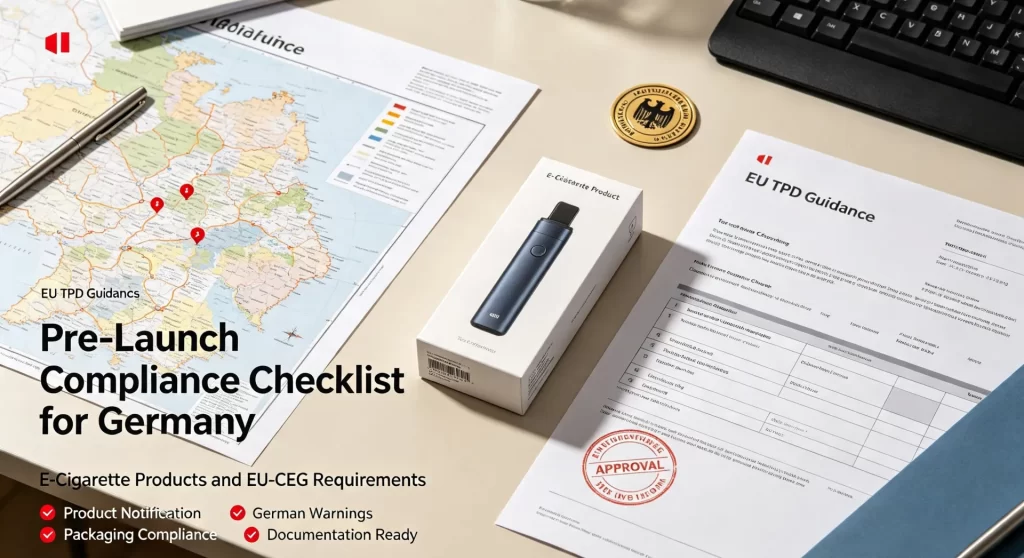
For businesses planning to enter the German market, the next step is to examine how the TPD is implemented under German legislation, including EU-CEG notification, packaging, labeling, advertising and other national requirements.
This article is provided for general regulatory information only and does not constitute legal advice. Businesses should verify the current requirements applicable to their products and target markets with the relevant authorities or qualified regulatory professionals.